HR Metrics and Analytics
Welcome
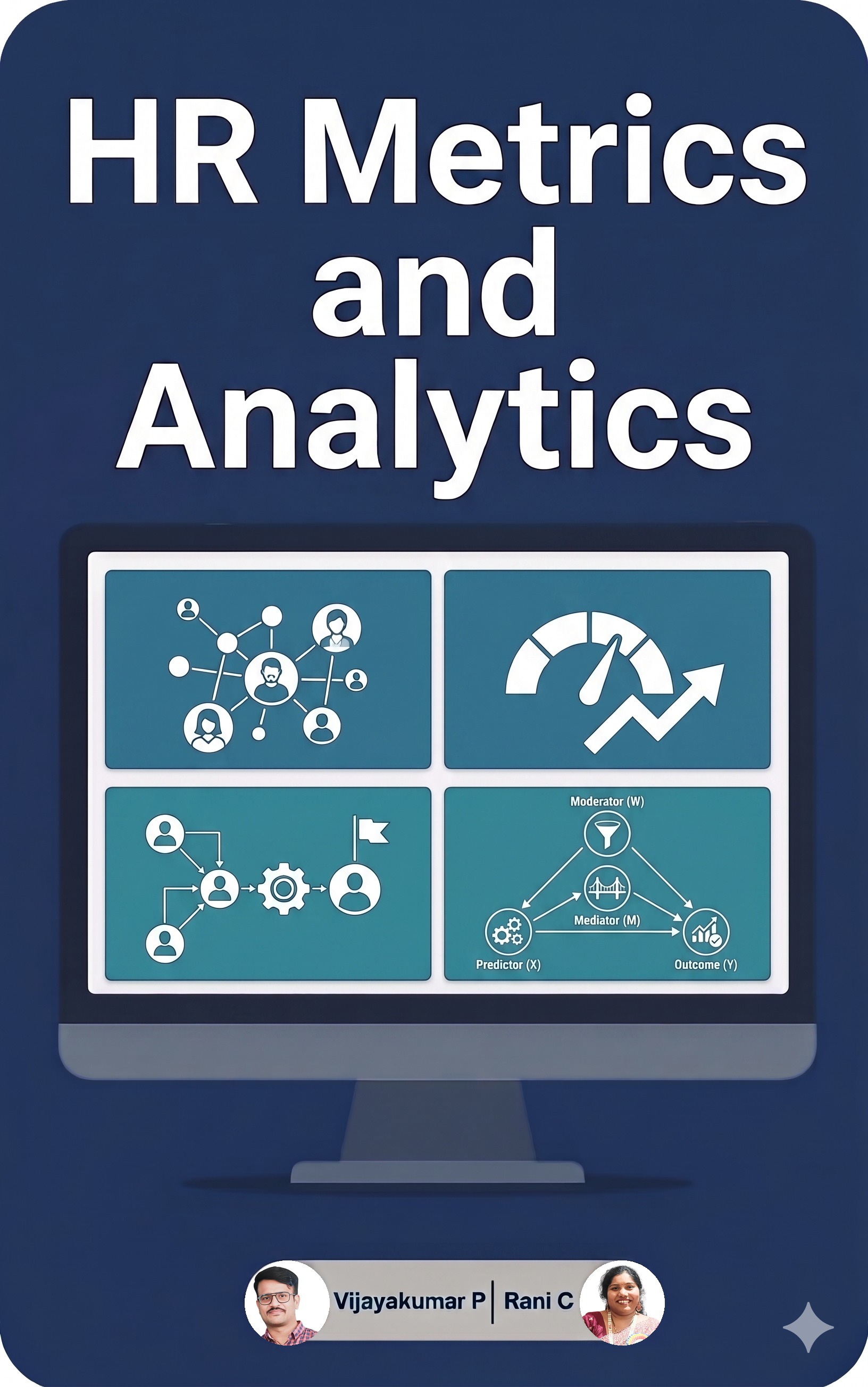
What’s inside every chapter
Each idea is built from first principles in plain language, so you understand what a metric measures and why it matters to the business.
Strategy maps, the LAMP model and HCM:21, with tables and diagrams that make each framework concrete and exam-ready.
Editable R and Python code blocks run in the browser, so you can compute metrics and test ideas as you read, no install needed.
Translate raw HR data into Excel dashboards and HRIS-driven reports that decision-makers can actually act on.
Measure inclusion, test diversity impact, and evaluate selection reliability, validity and bias with real analytical methods.
Mediation, moderation and interaction analysis, plus case studies that turn HR interventions into measurable outcomes.
Browse the modules
Welcome
In an era where data shapes every aspect of organizational decision-making, the ability to measure, interpret, and act on workforce information has become indispensable for HR professionals. Moving beyond intuition-based judgments to evidence-based practices allows organizations to align people decisions with strategy, build inclusive workplaces, and demonstrate the tangible value HR creates for the business.
HR Metrics and Analytics equips learners with the foundational concepts, design principles, and analytical techniques needed to translate workforce data into business insight. The book progresses through HR metric design and strategic alignment, the meaning and importance of HR analytics, Excel-based dashboards and HRIS data sources, frameworks such as LAMP and the HCM:21 Model, diversity and selection analytics, performance and training evaluation, and advanced techniques including mediation, moderation, and interaction analysis that support evidence-based HR practices.
Whether you are a student preparing for a career in human resources or a working professional looking to strengthen your analytical edge, this book offers the conceptual grounding and practical context to lead modern HR functions with confidence. Real-world case studies in HR analytics are integrated throughout to bridge theory and practice.
How to use this book
Read a topic top to bottom the first time: each builds a concept from the ground up, anchors it in a framework or model, and lets you run the code live to see the result. Type into the editable R and Python blocks and re-run them, that is where the learning sticks. The Syllabus page is your map to every module and topic, and the Live Analysis page lets you experiment with R and Python right in the browser.
About the authors

Vijayakumar P is an Educator & Data Analytics Professional with 8+ years in Analytics, AI and HR. UGC-JRF-NET in Management.

Rani C is an Educator & HR Business Intelligence Professional with 8+ years in HRM and HR Analytics. UGC-NET in Management.
References
- People Analytics in the Era of Big Data: Changing the Way You Attract, Acquire, Develop, and Retain Talent. Isson, J. P., & Harriott, J. S. (2016). Wiley.
- The Power of People: Learn How Successful Organizations Use Workforce Analytics to Improve Business Performance. Guenole, N., Ferrar, J., & Feinzig, S. (2017). Pearson FT Press.
- Predictive HR Analytics: Mastering the HR Metric. Edwards, M. R., & Edwards, K. (2019). (2nd ed.). Kogan Page.
- The New HR Analytics: Predicting the Economic Value of Your Company’s Human Capital Investments. Fitz-enz, J. (2010). AMACOM.
- Competing on Analytics: The New Science of Winning. Davenport, T. H., & Harris, J. G. (2007). Harvard Business Review Press.
- HR Analytics: The What, Why, and How of People Analytics. Sesil, J. C. (2014). Pearson FT Press.
- HR Analytics for Business Excellence. Waghmode, M. L., Shukla, M., & Kalse, A. (2024). RK Publications.
- HR Metrics: The World Class Way. Sullivan, J. (2003). Kennedy Information.
Reference Books
- Predictive Analytics for Human Resources. Fitz-enz, J., & Mattox II, J. (2014). Wiley.
- Data Driven HR: How to Use Analytics and Metrics to Drive Performance. Marr, B. (2018). Kogan Page.